

UGO Safety Explains the EN 388 Standard for Cut Resistance Gloves
During a recent visit to UGO Safety, a global steel coil manufacturer explored our cut resistance glove solutions designed for demanding industrial environments. The discussion focused on how gloves are tested according to EN 388 standards and why standardized evaluation is essential when selecting hand protection for mechanical risks.
The glove presented during the visit achieved Heavy Blade Cut Resistance Level C, a classification commonly required in environments involving sharp materials and continuous handling hazards.
What Is the EN 388 Standard?
The EN 388 standard is a European testing standard used to evaluate the protective performance of safety gloves against mechanical hazards.
It provides a structured and measurable framework to assess glove performance when exposed to:
-
Abrasion
-
Cutting risks
-
Tearing forces
-
Puncture hazards
Across industries such as construction, manufacturing, metal processing, logistics, and warehousing, EN 388 has become one of the most recognized references for hand protection evaluation.
Rather than relying on thickness or material appearance alone, standardized testing allows companies to compare gloves objectively and select protection based on real task risks.
How EN 388 Ratings Work
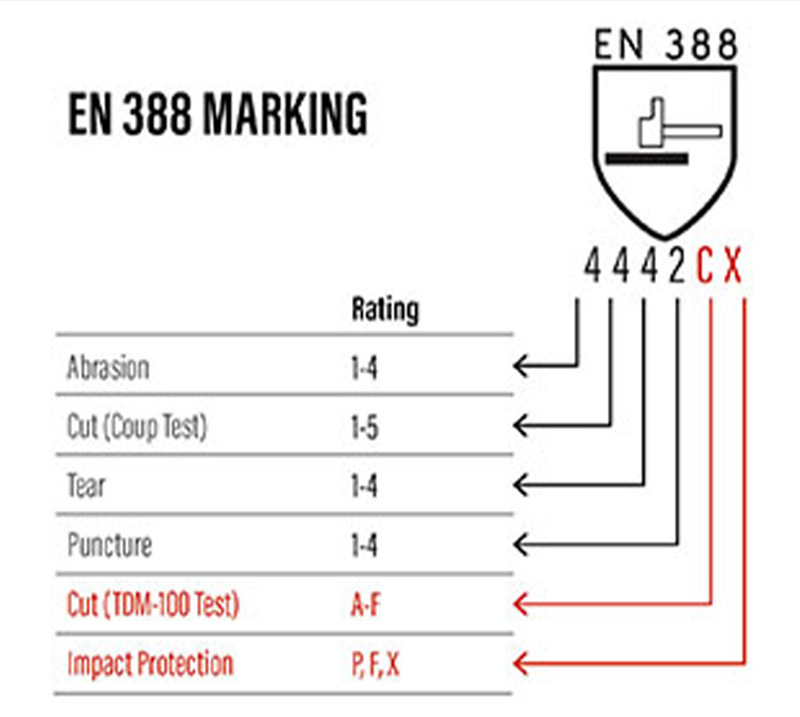
EN 388 markings appear as a sequence of five digits or characters, each representing a different performance test simulating real mechanical stress conditions.
1. Abrasion Resistance (First Digit)
This test measures how many abrasion cycles glove material withstands against sandpaper under controlled pressure and motion.
Rating: Level 1–4
Higher levels indicate stronger durability and resistance to surface wear during repetitive handling tasks.
2. Light Cut Resistance — Coup Test (Second Digit)
A rotating circular blade applies constant pressure to evaluate cutting resistance.
Rating: Level 1–5
If the blade dulls before penetrating the material, the result becomes:
“X” — indicating the glove proceeds to heavy cut testing for accurate evaluation.
3. Tear Resistance (Third Digit)
This test measures the force required to continue tearing material once damage begins.
Rating: Level 1–4
Higher tear resistance helps maintain glove integrity during pulling or snagging situations.
4. Puncture Resistance (Fourth Digit)
Determines the force required for a standardized nail to puncture the glove while stretched.
Rating: Level 1–4
This indicates protection against sharp points or protruding objects commonly encountered in material handling operations.
5. Heavy Cut Resistance — ISO 13997 Test (Fifth Character)
When gloves exceed the limits of the Coup Test, a more demanding evaluation is conducted using:
-
A straight blade test until it needs to be increased
-
Increasing applied force once passing the threshold
-
A new blade for each cut
Rating: A–F
-
A = lowest resistance
-
F = highest resistance
Level C and above are frequently specified for metal and sharp-edge handling applications.
Example: Understanding an EN 388 Rating (4X33C)
A glove marked 4X33C indicates:
| Performance Category | Rating |
|---|---|
| Abrasion Resistance | Level 4 |
| Light Cut Resistance | X (Skipped) |
| Tear Resistance | Level 3 |
| Puncture Resistance | Level 3 |
| Heavy Cut Resistance | Level C |
This classification identifies a glove suitable for demanding mechanical environments requiring reliable cut protection.
Why UGO Safety Focuses on Risk-Based Glove Selection
At UGO Safety, discussions with industrial partners focus on interpreting standards correctly rather than simply comparing numbers.
A higher cut level does not automatically mean a glove is suitable for every application. Proper selection must also consider:
-
Dexterity requirements
-
Comfort during long shifts
-
Grip performance
-
Task duration
-
Productivity impact
Balancing protection and usability helps ensure both safety compliance and operational efficiency.
The Role of EN 388 in Responsible PPE Selection
Standardized testing bridges the gap between laboratory performance and real-world workplace conditions.
By selecting gloves tested under EN 388, organizations demonstrate responsibility toward:
-
Worker safety
-
Operational reliability
-
Compliance with PPE requirements
At UGO Safety, this approach supports informed PPE decisions by translating technical test results into practical protection guidance for industrial users.
You can find our cut resistance glove in our UGO Safety Catalog
